
Custom Envelope Functions#
This notebook shows how to implement a Gaussian spot envelope by subclassing
EnvelopeFunction, and how to progressively add closed-form analytic expressions
for Gamma_hat(omega) and R_Gamma(tlag).
check_functions() is used at each step to verify the analytic implementation
against the FFT-based numerical baseline and to measure the accuracy and runtime
speedup of each approach.
Sections
Analytic equations for the Gaussian envelope
Minimal implementation —
Gamma(t)onlyAdd analytic
Gamma_hat(omega)— accuracy and timingAdd analytic
R_Gamma(tlag)— accuracy and timingBuild a
SpotEvolutionModelwith the finished envelope
import sys
sys.path.append("../..")

import time
import numpy as np
import matplotlib.pyplot as plt
import jax.numpy as jnp

from spotgp import (
    EnvelopeFunction,
    VisibilityFunction,
    SpotEvolutionModel,
    AnalyticKernel,
)

label_fs = 18
np.random.seed(42)
1. Analytic equations for the Gaussian envelope#
A Gaussian spot profile is centred at \(t = 0\) with standard deviation \(\sigma\):
The Fourier transform and autocorrelation both have closed forms.
Fourier transform \(\hat{\Gamma}(\omega)\)#
The Fourier transform of a Gaussian is a Gaussian:
Autocorrelation \(R_{\Gamma}(\tau)\)#
Both expressions are real and symmetric, and the integrals converge for all \(\sigma > 0\).
2. Minimal implementation — Gamma(t) only#
The only required methods are tau_spot (a property returning the
characteristic timescale) and Gamma(t). Everything else — Gamma_hat,
R_Gamma, kernel_support, param_dict — has working defaults in the base
class that fall back to FFT-based numerical approximations.
check_functions() detects which functions have been overridden and reports
no analytic overrides found when only the numerical fallbacks are in use.
class GaussianEnvelopeNumerical(EnvelopeFunction):
    """Gaussian spot envelope — Gamma(t) only, no analytic overrides."""

    def __init__(self, sigma: float):
        self._sigma = float(sigma)

    @property
    def tau_spot(self) -> float:
        return self._sigma

    @property
    def param_dict(self) -> dict:
        return {"sigma": self._sigma}

    def Gamma(self, t):
        return jnp.exp(-0.5 * (t / self._sigma) ** 2)
env_num = GaussianEnvelopeNumerical(sigma=5.0)
print("param_dict     :", env_num.param_dict)
print("tau_spot       :", env_num.tau_spot)
print("kernel_support :", env_num.kernel_support(), "days")
print()
errors = env_num.check_functions()
print("errors:", errors)
param_dict     : {'sigma': 5.0}
tau_spot       : 5.0
kernel_support : 30.0 days

GaussianEnvelopeNumerical: no analytic overrides found for Gamma_hat or R_Gamma — nothing to check.
errors: {}
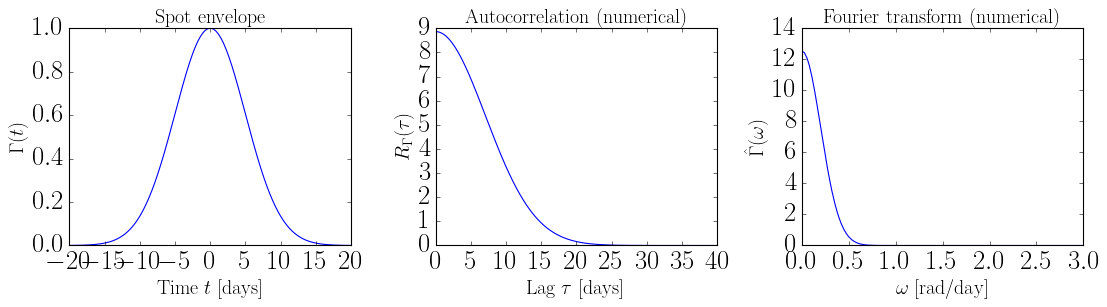
t   = np.linspace(-20, 20, 500)
lag = np.linspace(0, 40, 500)
om  = np.linspace(0, 3, 500)

fig, axes = plt.subplots(1, 3, figsize=(14, 4))

axes[0].plot(t, env_num.Gamma(jnp.array(t)))
axes[0].set_xlabel(r"Time $t$ [days]", fontsize=label_fs)
axes[0].set_ylabel(r"$\Gamma(t)$", fontsize=label_fs)
axes[0].set_title("Spot envelope", fontsize=label_fs)

axes[1].plot(lag, env_num.R_Gamma(jnp.array(lag)))
axes[1].set_xlabel(r"Lag $\tau$ [days]", fontsize=label_fs)
axes[1].set_ylabel(r"$R_\Gamma(\tau)$", fontsize=label_fs)
axes[1].set_title("Autocorrelation (numerical)", fontsize=label_fs)

axes[2].plot(om, env_num.Gamma_hat(jnp.array(om)))
axes[2].set_xlabel(r"$\omega$ [rad/day]", fontsize=label_fs)
axes[2].set_ylabel(r"$\hat{\Gamma}(\omega)$", fontsize=label_fs)
axes[2].set_title("Fourier transform (numerical)", fontsize=label_fs)

fig.tight_layout()
plt.show()
3. Add analytic Gamma_hat(omega)#
Override Gamma_hat with the closed-form Gaussian Fourier transform.
check_functions() will now detect the override and compare it to the
FFT baseline, reporting the RMSE and max absolute error.
class GaussianEnvelopeAnalyticFT(EnvelopeFunction):
    """Gaussian envelope with analytic Gamma_hat(omega)."""

    def __init__(self, sigma: float):
        self._sigma = float(sigma)

    @property
    def tau_spot(self) -> float:
        return self._sigma

    @property
    def param_dict(self) -> dict:
        return {"sigma": self._sigma}

    def Gamma(self, t):
        return jnp.exp(-0.5 * (t / self._sigma) ** 2)

    def Gamma_hat(self, omega):
        # FT of Gaussian: sigma * sqrt(2*pi) * exp(-omega^2 * sigma^2 / 2)
        return self._sigma * jnp.sqrt(2 * jnp.pi) * jnp.exp(-0.5 * (omega * self._sigma) ** 2)
Check that our analytic equation is correct by comparing it to the numerical solution:
env_ft = GaussianEnvelopeAnalyticFT(sigma=5.0)
errors_ft = env_ft.check_functions()
Gamma_hat  RMSE = 2.27e-04,  max err = 1.92e-03
  analytic  time = 0.690 ms
  numerical time = 0.065 ms
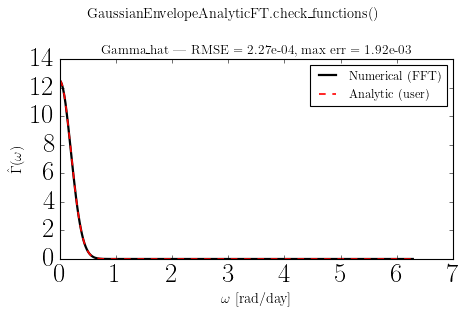
For this evaluation the analytic time is slower than the numerical time because of the JAX JIT compilation on the first run. As a better comparison, we can compare the timing after JIT warmup.
Timing: analytic vs numerical Gamma_hat#
Compare evaluation time for 1 000 calls on a 500-point omega grid.
omega_arr = jnp.linspace(0, 3.0, 500)
n_calls   = 1000

# Ensure both numerical grids are pre-built before timing
env_num._ensure_numerical_grids()
env_ft._ensure_numerical_grids()

# Warm up JAX JIT
_ = env_num.Gamma_hat(omega_arr)
_ = env_ft.Gamma_hat(omega_arr)

t0 = time.perf_counter()
for _ in range(n_calls):
    env_num.Gamma_hat(omega_arr)
t_numerical = (time.perf_counter() - t0) / n_calls * 1e3

t0 = time.perf_counter()
for _ in range(n_calls):
    env_ft.Gamma_hat(omega_arr)
t_analytic = (time.perf_counter() - t0) / n_calls * 1e3

print(f"Gamma_hat  numerical : {t_numerical:.3f} ms/call")
print(f"Gamma_hat  analytic  : {t_analytic:.3f} ms/call")
print(f"Speedup              : {t_numerical / t_analytic:.1f}x")
Gamma_hat  numerical : 0.193 ms/call
Gamma_hat  analytic  : 0.129 ms/call
Speedup              : 1.5x
If you were to increase n_pts to something large (e.g. 100k+), the analytic version would likely pull ahead because the np.interp of the numerical solution cost grows linearly while the JIT-compiled XLA kernel stays roughly flat.
4. Add analytic R_Gamma(tlag)#
Override R_Gamma with the closed-form Gaussian autocorrelation.
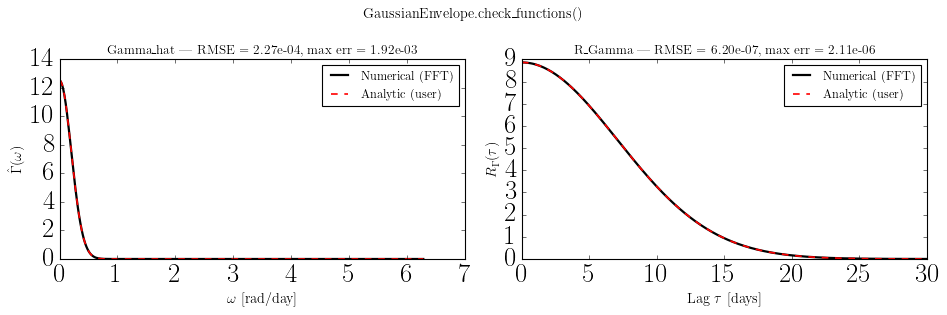
check_functions() now checks both overrides simultaneously.
class GaussianEnvelope(EnvelopeFunction):
    """
    Gaussian spot envelope with fully analytic Gamma_hat and R_Gamma.

    Parameters
    ----------
    sigma : float
        Standard deviation of the Gaussian profile [days].
    """

    def __init__(self, sigma: float):
        self._sigma = float(sigma)

    @property
    def tau_spot(self) -> float:
        return self._sigma

    @property
    def param_dict(self) -> dict:
        return {"sigma": self._sigma}

    def Gamma(self, t):
        return jnp.exp(-0.5 * (t / self._sigma) ** 2)

    def Gamma_hat(self, omega):
        # FT of Gaussian: sigma * sqrt(2*pi) * exp(-omega^2 * sigma^2 / 2)
        return self._sigma * jnp.sqrt(2 * jnp.pi) * jnp.exp(-0.5 * (omega * self._sigma) ** 2)

    def R_Gamma(self, lag):
        # Autocorrelation of Gaussian: sigma * sqrt(pi) * exp(-lag^2 / (4*sigma^2))
        return self._sigma * jnp.sqrt(jnp.pi) * jnp.exp(-0.25 * (lag / self._sigma) ** 2)
env = GaussianEnvelope(sigma=5.0)
errors = env.check_functions()
Gamma_hat  RMSE = 2.27e-04,  max err = 1.92e-03
  analytic  time = 0.747 ms
  numerical time = 0.049 ms
R_Gamma  RMSE = 6.20e-07,  max err = 2.11e-06
  analytic  time = 0.755 ms
  numerical time = 0.048 ms
Timing: analytic vs numerical for both functions#
Compare R_Gamma and Gamma_hat evaluation time across 1 000 calls on a
500-point grid.
lag_arr   = jnp.linspace(0, 6 * env.tau_spot, 500)
omega_arr = jnp.linspace(0, 3.0, 500)
n_calls   = 1000

# Pre-build numerical grids and warm up
env_num._ensure_numerical_grids()
env._ensure_numerical_grids()
_ = env_num.R_Gamma(lag_arr);   _ = env.R_Gamma(lag_arr)
_ = env_num.Gamma_hat(omega_arr); _ = env.Gamma_hat(omega_arr)

results = {}
for label, obj, arr, fname in [
    ("numerical", env_num, lag_arr,   "R_Gamma"),
    ("analytic",  env,     lag_arr,   "R_Gamma"),
    ("numerical", env_num, omega_arr, "Gamma_hat"),
    ("analytic",  env,     omega_arr, "Gamma_hat"),
]:
    func = getattr(obj, fname)
    t0 = time.perf_counter()
    for _ in range(n_calls):
        func(arr)
    results[(fname, label)] = (time.perf_counter() - t0) / n_calls * 1e3

print(f"{'Function':12s}  {'Method':10s}  {'ms/call':>9s}  {'speedup':>8s}")
print("-" * 48)
for fname in ("R_Gamma", "Gamma_hat"):
    t_num = results[(fname, "numerical")]
    t_an  = results[(fname, "analytic")]
    print(f"{fname:12s}  {'numerical':10s}  {t_num:9.3f}")
    print(f"{fname:12s}  {'analytic':10s}  {t_an:9.3f}  {t_num/t_an:7.1f}x")
Function      Method        ms/call   speedup
------------------------------------------------
R_Gamma       numerical       0.184
R_Gamma       analytic        0.127      1.4x
Gamma_hat     numerical       0.161
Gamma_hat     analytic        0.130      1.2x
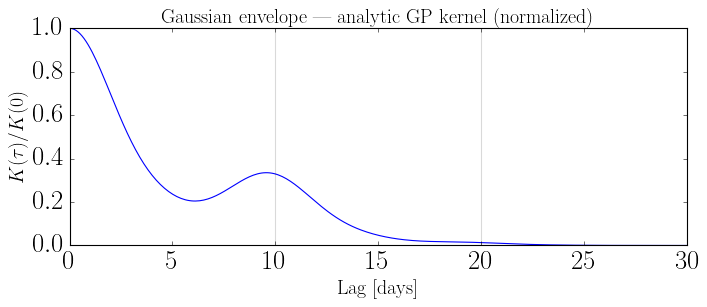
5. Build a SpotEvolutionModel with the Gaussian envelope#
The finished GaussianEnvelope plugs directly into SpotEvolutionModel and
AnalyticKernel just like any built-in envelope.
visibility = VisibilityFunction(
    peq=10.0,
    kappa=0.3,
    inc=np.pi / 3,
)

model = SpotEvolutionModel(
    envelope=GaussianEnvelope(sigma=5.0),
    visibility=visibility,
    sigma_k=0.01,
)

print("param_keys:", model.param_keys)
print(model)
param_keys: ('peq', 'kappa', 'inc', 'sigma', 'sigma_k')
SpotEvolutionModel(
  envelope=GaussianEnvelope({'sigma': 5.0}),
  visibility=VisibilityFunction(peq=10.0, kappa=0.3, inc=1.047),
  sigma_k=0.01
)
ak = AnalyticKernel(model).build_jax()

lag = np.linspace(0, 3 * model.peq, 300)
K   = ak.kernel(lag)

fig, ax = plt.subplots(figsize=(9, 4))
ax.plot(lag, K / K[0])
for n in range(int(lag[-1] / model.peq) + 1):
    ax.axvline(n * model.peq, color="k", alpha=0.15, lw=1)
ax.set_xlabel("Lag [days]", fontsize=label_fs)
ax.set_ylabel(r"$K(\tau) / K(0)$", fontsize=label_fs)
ax.set_title("Gaussian envelope — analytic GP kernel (normalized)", fontsize=label_fs)
fig.tight_layout()
plt.show()
JAX kernel compiled in 0.27s
JAX kernel recompute in 0.23s