

Data Preprocessing#
The TimeSeriesData class provides a standard container for photometric time series with built-in preprocessing, PSD, and ACF computation.
Sections
Creating a
TimeSeriesDatafrom simulated dataLoading Kepler data via
lightkurveNormalization, sigma clipping, PSD, and ACF
import sys
sys.path.append("../..")

import numpy as np
import matplotlib.pyplot as plt

plt.rcParams.update({
    "font.size":        16,   # base font size
    "axes.titlesize":   20,   # axes title
    "axes.labelsize":   18,   # x/y axis labels
    "xtick.labelsize":  14,   # x tick labels
    "ytick.labelsize":  14,   # y tick labels
    "legend.fontsize":  14,
    "figure.titlesize": 22,   # suptitle
    "axes.formatter.useoffset": False,  # disable scientific notation offset
})

from spotgp import TimeSeriesData
1. Simulated data#
Create a synthetic lightcurve with a periodic signal, noise, and a few outliers.
np.random.seed(42)

N = 500
t = np.sort(np.random.uniform(0, 100, N))  # irregular sampling
period = 8.0
flux = 1.0 + 0.005 * np.sin(2 * np.pi * t / period) + 0.001 * np.random.randn(N)
flux_err = np.full(N, 0.001)

# Inject some outliers and NaNs
flux[10] = 1.05
flux[200] = 0.95
flux[300] = np.nan

ts = TimeSeriesData(t, flux, flux_err)
print(ts)
print(f"Median flux: {np.median(ts.y):.6f}")
TimeSeriesData(N=499, baseline=98.79, median_dt=0.1299)
Median flux: 1.000000
The constructor automatically:
Removed the NaN entry (N went from 500 to 499)
Normalized the flux so the median is 1.0
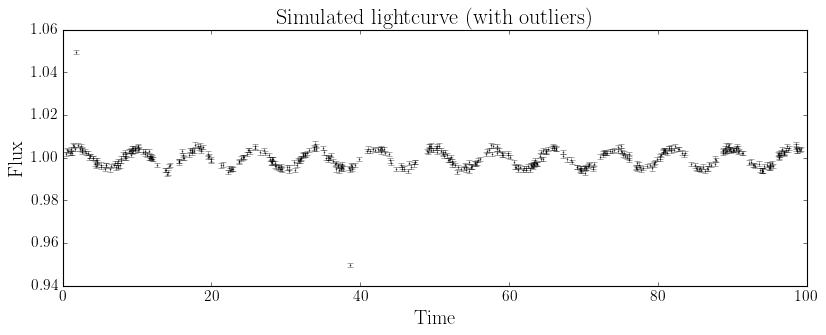
Plot the raw time series#
ts.plot()
plt.title("Simulated lightcurve (with outliers)")
plt.show()
Sigma clipping#
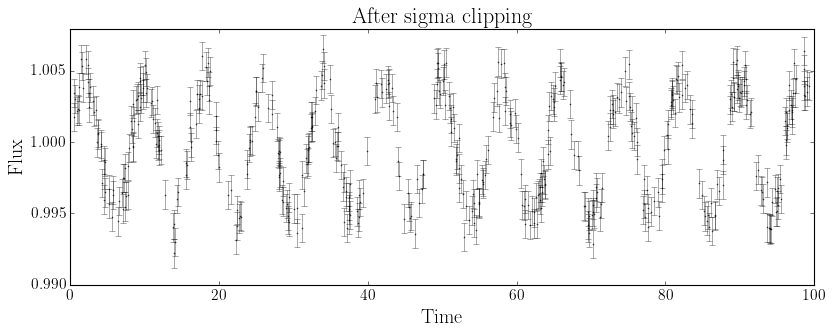
Remove the outliers with sigma_clip():
print(f"Before clipping: N = {ts.N}")
ts.sigma_clip(lower=3, upper=3)
print(f"After clipping:  N = {ts.N}")

ts.plot()
plt.title("After sigma clipping")
plt.show()
Before clipping: N = 499
After clipping:  N = 497
Downsampling#
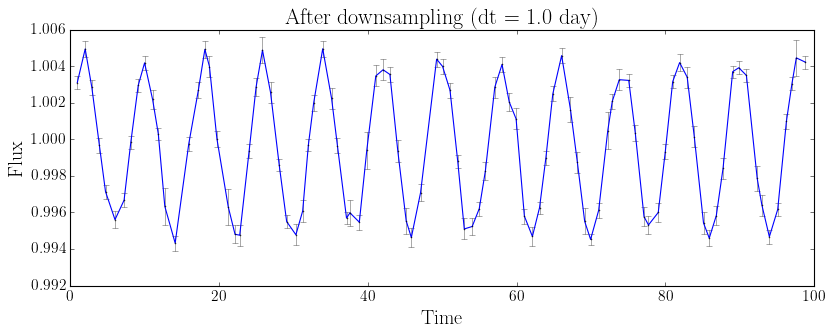
Bin the time series into uniform time bins using inverse-variance weighted averaging. This reduces the number of points while preserving the signal and correctly propagating uncertainties.
print(f"Before downsampling: N = {ts.N}, median dt = {ts.median_dt:.4f}")
ts.downsample(dt=1.0)
print(f"After downsampling:  N = {ts.N}, median dt = {ts.median_dt:.4f}")

ts.plot()
plt.plot(ts.x, ts.y)
plt.title("After downsampling (dt = 1.0 day)")
plt.show()
Before downsampling: N = 497, median dt = 0.1311
After downsampling:  N = 97, median dt = 0.9924
PSD and ACF#
Compute and plot the power spectral density and autocorrelation function:
fig, axes = plt.subplots(1, 2, figsize=(14, 4))

ts.plot_psd(ax=axes[0])
axes[0].axvline(1.0 / period, color="r", ls="--", label=f"Injected: $f = 1/{period:.0f}$ d$^{{-1}}$")
axes[0].legend()
axes[0].set_title("Lomb-Scargle PSD")

ts.plot_acf(ax=axes[1], n_bins=100, max_lag=40)
for i in range(1, 5):
    axes[1].axvline(i * period, color="r", ls="--", alpha=0.4)
axes[1].set_title("Autocorrelation function")

plt.tight_layout()
plt.show()
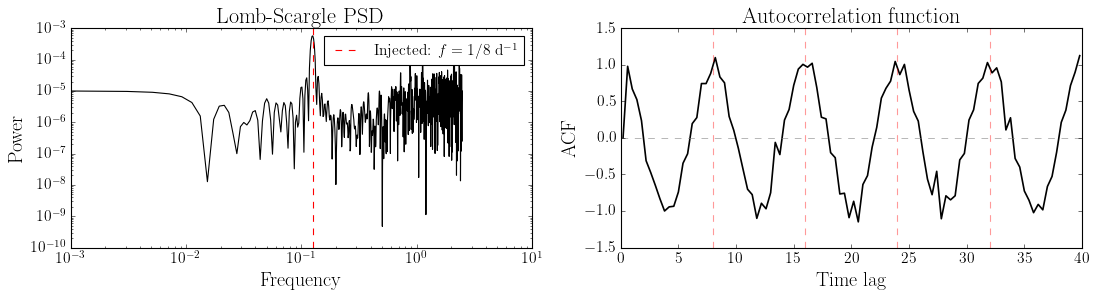
The PSD peaks at the injected frequency (\(1/8\) d\(^{-1}\)) and the ACF shows periodicity at multiples of 8 days.
2. Kepler data with lightkurve#
Load a Kepler quarter for a known active star and preprocess it with TimeSeriesData.
Note
This section requires lightkurve. Install it with pip install lightkurve.
import lightkurve as lk

# Download a single Kepler quarter for a spotted star
search = lk.search_lightcurve("KIC 7985370", mission="Kepler", cadence="long", quarter=5)
lc = search.download()
lc.head()
| time | flux | flux_err | quality | timecorr | centroid_col | centroid_row | cadenceno | sap_flux | sap_flux_err | sap_bkg | sap_bkg_err | pdcsap_flux | pdcsap_flux_err | sap_quality | psf_centr1 | psf_centr1_err | psf_centr2 | psf_centr2_err | mom_centr1 | mom_centr1_err | mom_centr2 | mom_centr2_err | pos_corr1 | pos_corr2 |
|---|---|---|---|---|---|---|---|---|---|---|---|---|---|---|---|---|---|---|---|---|---|---|---|---|
| electron / s | electron / s | d | pix | pix | electron / s | electron / s | electron / s | electron / s | electron / s | electron / s | pix | pix | pix | pix | pix | pix | pix | pix | pix | pix | ||||
| Time | float32 | float32 | int32 | float32 | float64 | float64 | int32 | float32 | float32 | float32 | float32 | float32 | float32 | int32 | float64 | float32 | float64 | float32 | float64 | float32 | float64 | float32 | float32 | float32 |
| 443.48970645623194 | ——— | ——— | 10000 | -1.448464e-03 | 319.40248 | 398.02002 | 16373 | 1.5593305e+06 | 3.1996595e+01 | 8.0061802e+03 | 1.6346836e+00 | ——— | ——— | 10000 | ——— | ——— | ——— | ——— | 319.40248 | 2.0221185e-05 | 398.02002 | 2.9403081e-05 | -4.5754738e-02 | 4.8700325e-02 |
| 443.51014069512166 | 1.5641606e+06 | 3.2047684e+01 | 10000000010000 | -1.447925e-03 | 319.40256 | 398.02001 | 16374 | 1.5606115e+06 | 3.2009605e+01 | 8.0055918e+03 | 1.6347697e+00 | 1.5641606e+06 | 3.2047684e+01 | 10000000010000 | ——— | ——— | ——— | ——— | 319.40256 | 2.0208812e-05 | 398.02001 | 2.9394563e-05 | -4.5619853e-02 | 4.9024601e-02 |
| 443.5305747343591 | 1.5655112e+06 | 3.2063877e+01 | 10000000010000 | -1.447386e-03 | 319.40289 | 398.01947 | 16375 | 1.5619460e+06 | 3.2023129e+01 | 8.0033838e+03 | 1.6351467e+00 | 1.5655112e+06 | 3.2063877e+01 | 10000000010000 | ——— | ——— | ——— | ——— | 319.40289 | 2.0198473e-05 | 398.01947 | 2.9383289e-05 | -4.5340929e-02 | 4.8469041e-02 |
| 443.55100887370645 | 1.5667932e+06 | 3.2078529e+01 | 10000 | -1.446846e-03 | 319.40306 | 398.01928 | 16376 | 1.5632136e+06 | 3.2036301e+01 | 8.0128496e+03 | 1.6329130e+00 | 1.5667932e+06 | 3.2078529e+01 | 10000 | ——— | ——— | ——— | ——— | 319.40306 | 2.0186624e-05 | 398.01928 | 2.9375227e-05 | -4.5147281e-02 | 4.8476472e-02 |
| 443.5714431134111 | 1.5680732e+06 | 3.2089455e+01 | 10010000 | -1.446307e-03 | 319.40302 | 398.01933 | 16377 | 1.5645386e+06 | 3.2048767e+01 | 8.0063745e+03 | 1.6347470e+00 | 1.5680732e+06 | 3.2089455e+01 | 10010000 | ——— | ——— | ——— | ——— | 319.40302 | 2.0174755e-05 | 398.01933 | 2.9367231e-05 | -4.5176014e-02 | 4.8612297e-02 |
ts_kepler = TimeSeriesData.from_lightkurve(lc, normalize=True)
print(ts_kepler)
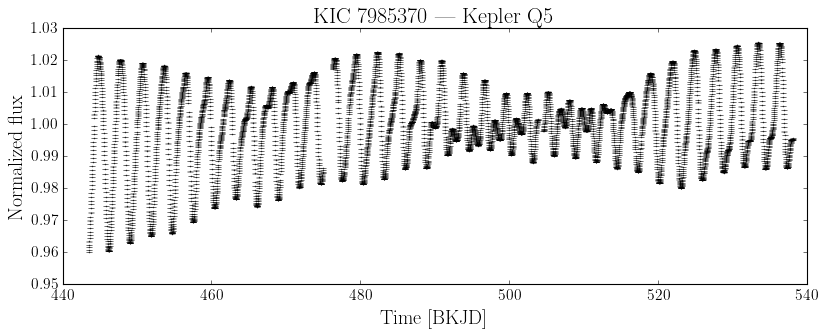
TimeSeriesData(N=4486, baseline=94.65, median_dt=0.0204)
Plot the raw lightcurve#
ts_kepler.plot(xlabel="Time [BKJD]", ylabel="Normalized flux")
plt.title("KIC 7985370 — Kepler Q5")
plt.show()
Downsample#
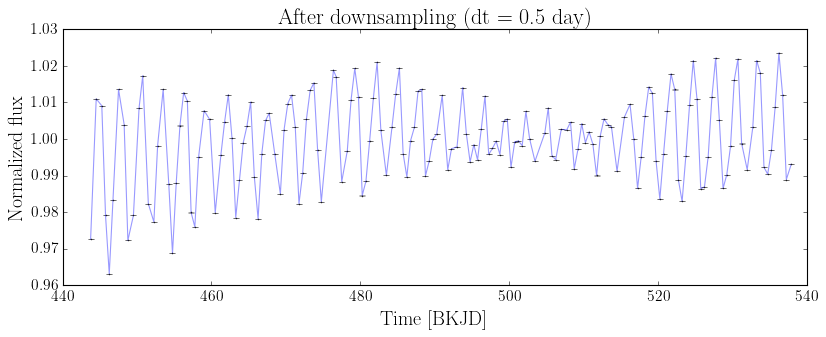
Kepler long-cadence data has ~30 min sampling. Downsample to 1-day bins to speed up GP fitting:
print(f"Before downsampling: N = {ts_kepler.N}, median dt = {ts_kepler.median_dt:.4f}")
ts_kepler.downsample(dt=0.5)
print(f"After downsampling:  N = {ts_kepler.N}, median dt = {ts_kepler.median_dt:.4f}")

ts_kepler.plot(xlabel="Time [BKJD]", ylabel="Normalized flux")
plt.plot(ts_kepler.x, ts_kepler.y, alpha=0.4)
plt.title("After downsampling (dt = 0.5 day)")
plt.show()
Before downsampling: N = 187, median dt = 0.5006
After downsampling:  N = 169, median dt = 0.5006
PSD and ACF#
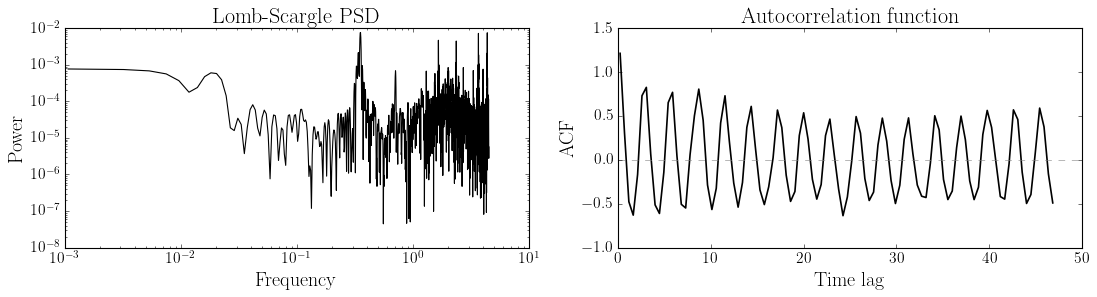
fig, axes = plt.subplots(1, 2, figsize=(14, 4))

ts_kepler.plot_psd(ax=axes[0])
axes[0].set_title("Lomb-Scargle PSD")

ts_kepler.plot_acf(ax=axes[1], n_bins=100)
axes[1].set_title("Autocorrelation function")

plt.tight_layout()
plt.show()
Summary panel#
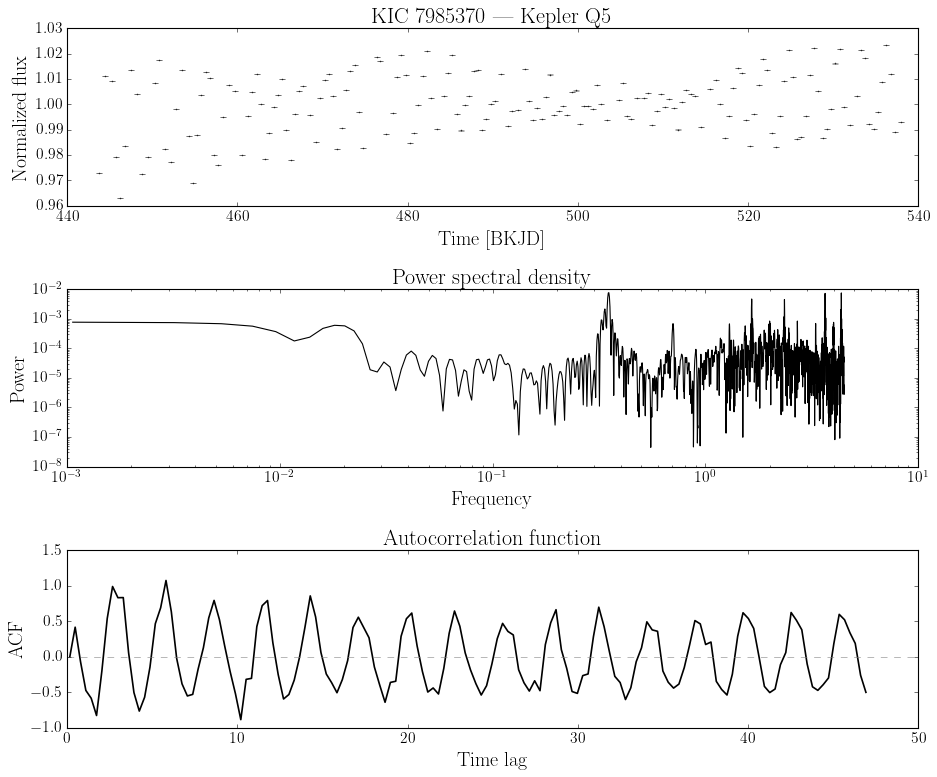
A combined three-panel view of the data:
fig, axes = plt.subplots(3, 1, figsize=(12, 10))

ts_kepler.plot(ax=axes[0], xlabel="Time [BKJD]", ylabel="Normalized flux")
axes[0].set_title("KIC 7985370 — Kepler Q5")

ts_kepler.plot_psd(ax=axes[1])
axes[1].set_title("Power spectral density")

ts_kepler.plot_acf(ax=axes[2], n_bins=150)
axes[2].set_title("Autocorrelation function")

plt.tight_layout()
plt.show()
API summary#
Method |
Description |
|---|---|
|
Create from arrays (auto-removes NaN, normalizes by default) |
|
Create from a |
|
Divide flux by median |
|
Remove outliers beyond N-sigma |
|
Bin into non-overlapping intervals with inverse-variance weighted mean |
|
Lomb-Scargle PSD |
|
Binned empirical ACF |
|
Plot time series with error bars |
|
Plot PSD (log-log by default) |
|
Plot ACF |